
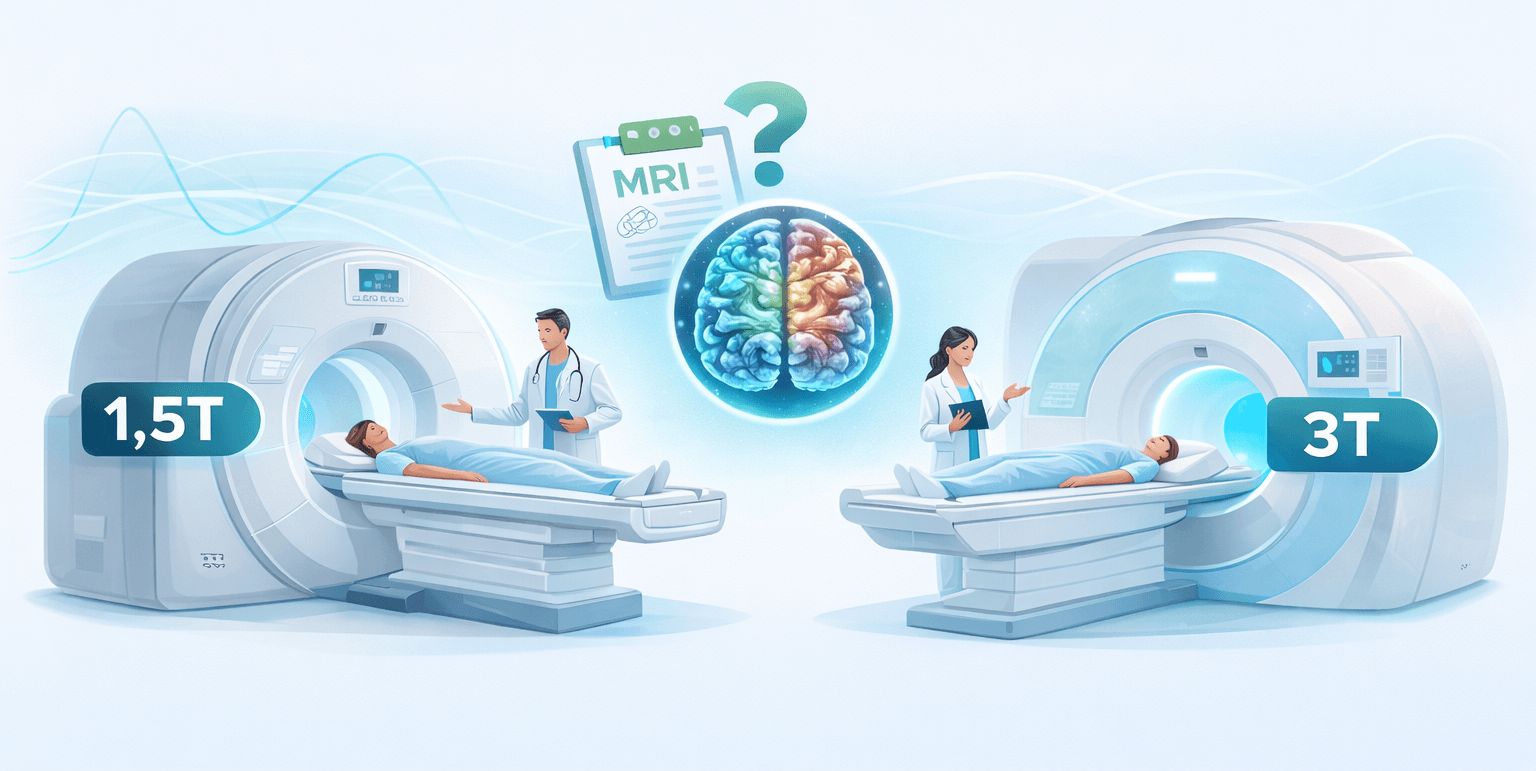
Would you like to know the difference between our 1.5T and 3T MRI examinations?
Magnetic resonance imaging (MRI) is one of the most advanced and accurate diagnostic imaging methods in modern medicine. At our center, we offer examinations using both 1.5T and 3T MRI scanners. What is the difference between them, and when does it make sense to choose the premium option? Here is a clear comparison.
What Do They Have in Common?
An experienced team of physicians and radiologic technologists with many years of practice, including supervision by a biomedical engineer with a scientific degree. You can expect a professional approach and high-quality, efficient examinations. We provide painless examinations in an attractive yet private and comfortable environment.
What Is the Difference?
Better Image Quality and Higher Resolution
The 3T MRI has a magnetic field that is twice as strong as 1.5T, increasing the signal-to-noise ratio (SNR) and resulting in sharper, more detailed images of the examined anatomy. This is particularly important for imaging small structures such as brain lesions, nerve plexuses, or fine joint structures that may be more difficult to visualize at 1.5T.
For you, this means a higher likelihood of detecting subtle findings.
Advanced Multiparametric Imaging
The 3T scanner is equipped with Deep Resolve technology. The configuration of the 3T MAGNETOM Vida scanner combined with Deep Resolve Boost & Sharp represents the forefront of modern radiology, integrating high magnetic field strength with advanced neural network intelligence.
For you, this means higher image quality while maintaining examination comfort.
Faster Scanning The higher SNR allows for shorter scan times while maintaining excellent image quality. This improves patient comfort and reduces the risk of motion artifacts.
For you, this means a shorter examination time.
Improved Imaging of Low-Proton Structures
Tissues such as cartilage, tendons, and bones have low proton density, making them more challenging to image at 1.5T. At 3T, these structures are more clearly visible, which is particularly beneficial in orthopedics and sports medicine.
For you, this means more accurate diagnostics, even in complex cases.
Better Detection of Pathologies
Thanks to higher contrast and sensitivity to tissue changes, 3T MRI enables better detection of small tumors, microscopic hemorrhages, and early signs of neurological diseases (e.g., multiple sclerosis, Alzheimer’s disease). The 3T MRI also plays an essential role in multiparametric prostate imaging.
For you, this means more precise diagnostics and a greater chance of early disease detection.